
Space Lab + Astronomy Curriculum for Schools
AstroEd puts a working Space Lab inside your school and wraps a structured, year-long astronomy curriculum around it. Students move from their first look through a telescope to understanding what they are actually seeing — across Grades 4 to 12, guided by trained astronomy educators using professional equipment.
It is built for schools that want astronomy to be part of the academic year, not a single assembly-hall event.
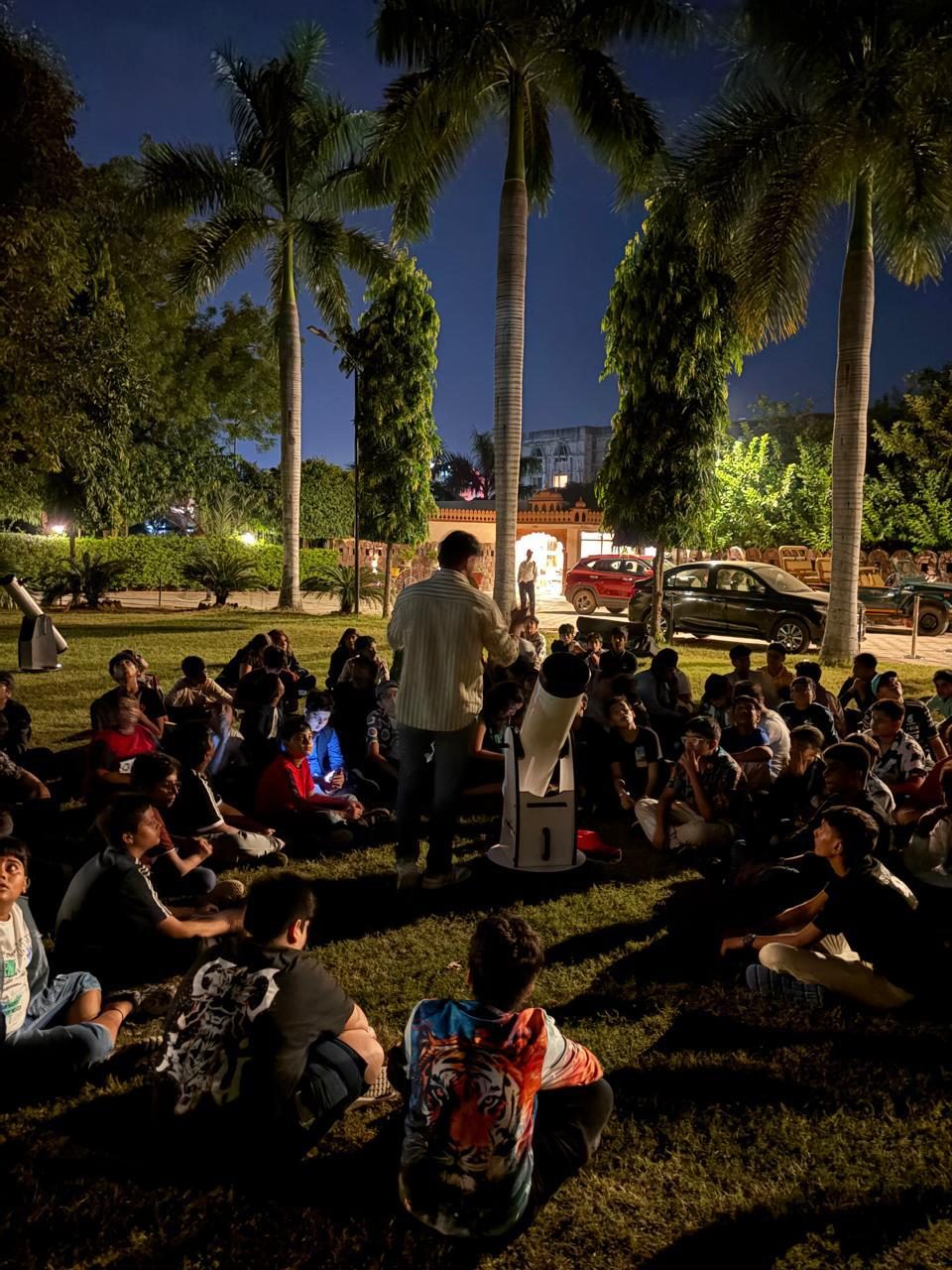
A telescope is a moment. Understanding the sky is an education.
Most schools meet astronomy once — a visiting telescope, a crowded queue, a few seconds at the eyepiece, and it is over. Students remember the novelty, not the science.
AstroEd is built the other way round. The equipment stays. The curriculum runs through the year. Observation is tied to what students are learning in class, so the night sky becomes a place they can navigate rather than a photograph they were shown.
The programme, end to end
Infrastructure, curriculum and delivery — designed to run through the academic year rather than as a one-off visit.
Space Lab
A dedicated astronomy space inside the school, equipped for observation and hands-on work — the physical home of the programme.
Yearly Astronomy Curriculum
A structured programme that runs across the academic year for Grades 4–12, building from fundamentals to independent projects.
Telescope & Observation
Guided night-sky and safe solar observation using professional telescopes, so students see the real object, not a textbook diagram.
Hands-on Activities
Model rocketry and physics-led STEM activities that turn abstract concepts into something students build and test.
Space Science Modules
Space-science modules aligned to the ISRO curriculum, delivered as part of the school year.
Immersive Experiences
VR journeys through the solar system for the scales and distances a classroom cannot otherwise convey.
Faculty Enablement
Sessions are delivered by trained astronomy educators, working alongside your science faculty.
An academic progression, not a lecture series
Six stages across the school year. Each one builds on what students can already find in the sky.
- 01
Foundation
Getting oriented: scale, motion, day and night, seasons — the mental model everything else rests on.
- 02
Observation
Reading the sky by eye and through a telescope. Constellations, the Moon, and how to actually find something.
- 03
Solar System
The planets, the Sun observed safely, and the mechanics that hold the system together.
- 04
Deep Sky
Beyond the solar system — star clusters, nebulae and galaxies, and what their light tells us.
- 05
Space Science
Rocketry, spaceflight and mission science, connected to ISRO-aligned space-science modules.
- 06
Projects
Students run their own observation and science projects — the point the programme has been building towards.
The detailed syllabus, session count and grade-wise mapping are prepared with your school during planning, around your academic calendar.
Equipment that stays in the building
The Space Lab is the physical home of the programme — a dedicated astronomy space with professional telescopes for night-sky and safe solar observation, room for hands-on work, and the equipment students need to run their own projects.
Because it lives in the school, observation is not limited to one scheduled evening. It becomes part of how science is taught.
What it looks like from a student’s side
They find it themselves
Students are taught to locate an object and point the telescope at it, rather than queueing for a view someone else set up.
They build and test
Model rocketry and physics activities put the theory in their hands, with an outcome they can measure.
They observe the Sun safely
Daytime solar observation with proper equipment makes astronomy possible within the school timetable.
They keep going
Because the lab and the curriculum stay in the school, interest has somewhere to go after the first session.
What the school ends up with
- Students can orient themselves in the night sky and locate objects without help
- Practical familiarity with telescopes and safe solar observation
- Physics and space-science concepts anchored to something students have seen and built
- A visible, year-round astronomy programme the school owns
- Science faculty supported by trained astronomy educators
Build a Space Lab at your school
Tell us about your school and we’ll put together a programme around your grades, facilities and academic calendar.